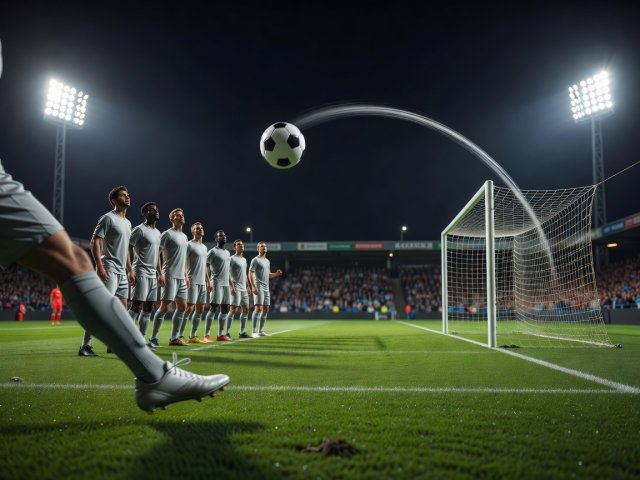
 Curl
Roberto Carlos v France
Lyon, 3 June 1997. Struck with the outside of the left foot from about 35 metres, it seemed to be heading for a ball boy before spiralling in.
Experiment 02 · Curl
A curling free kick is not magic. It is a spinning sphere pushing air one way so the air pushes it back the other. Learn the mechanism and you can control the bend.
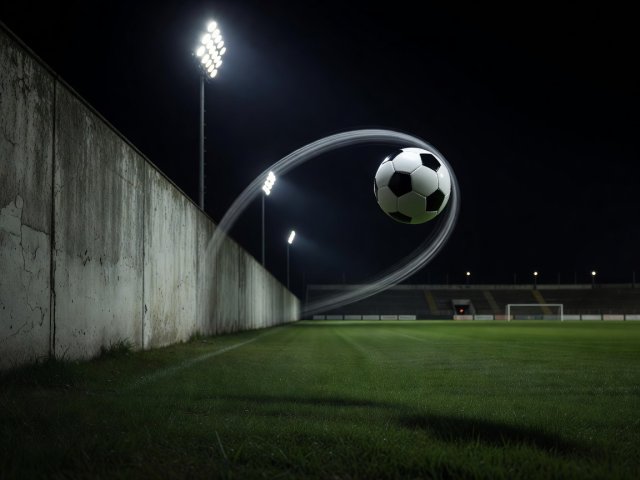
Picture the ball from above, spinning anticlockwise as it travels forward. The air immediately next to the surface, the boundary layer, is dragged along by that spin. On the side of the ball turning with the oncoming air, the boundary layer clings on longer before it breaks away. On the side turning into the air, it breaks away sooner.
The result is a wake that leaves the ball at an angle instead of straight behind it. If the ball throws air to one side, Newton's third law says the air throws the ball to the other. Isaac Newton himself noted something similar in 1672 when he watched tennis balls swerve at Cambridge. Heinrich Gustav Magnus measured it with spinning cylinders in Berlin in 1852, and his name stuck.
In practical terms: hit the right-hand side of the ball with the inside of your right foot and it spins anticlockwise and bends right to left. Wrap the outside of the boot round the left-hand side and you get the reverse, the "trivela" made famous by Ricardo Quaresma.
The sideways force grows with two things: how fast the ball spins and how fast it moves. A typical strong free kick leaves the boot at roughly 25 to 30 metres per second spinning several revolutions per second. Double the spin and you roughly increase the bend, up to the point where your technique loses accuracy.
Why do the best curlers seem to bend more at the end of their flight? Two effects stack up. First, air resistance slows the ball, but spin decays more slowly than speed, so the ratio of spin to speed rises and the curve tightens.
Second, footballs fly near a threshold physicists call the drag crisis. At high speed the boundary layer is turbulent and hugs the ball, keeping drag low. As the ball slows below a critical speed, the flow turns smooth, separates earlier, and drag jumps. The ball suddenly brakes and the sideways push becomes relatively stronger.
In 2010, Guillaume Dupeux, Christophe Clanet and colleagues published "The spinning ball spiral" in the New Journal of Physics. They showed that a spinning ball travelling far enough naturally follows a tightening spiral, and used Roberto Carlos's 1997 strike against France as the textbook case.
CurlLyon, 3 June 1997. Struck with the outside of the left foot from about 35 metres, it seemed to be heading for a ball boy before spiralling in.
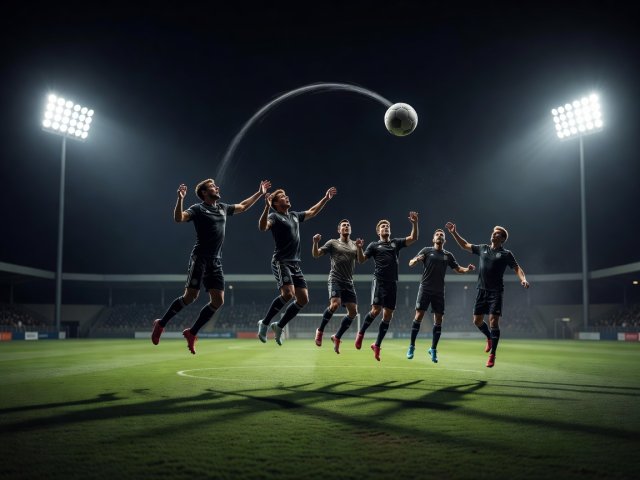 Curl
Old Trafford, 6 October 2001. Sidespin mixed with topspin produced both swerve and dip, beating the wall and the keeper's dive.
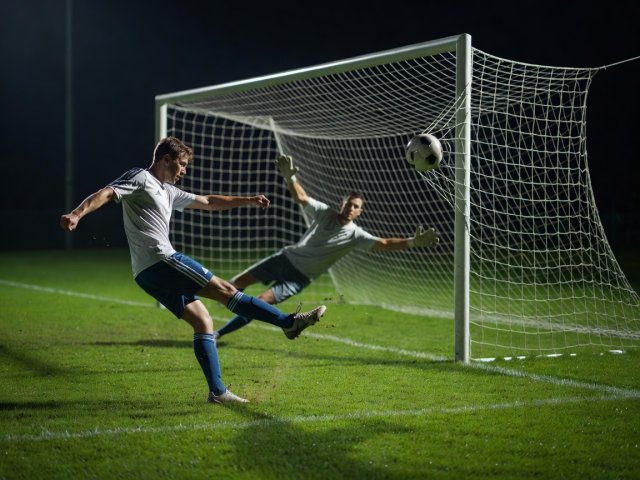 Curl
Short run-up, minimal backlift, high spin rate. Proof that bend comes from contact quality, not raw power.