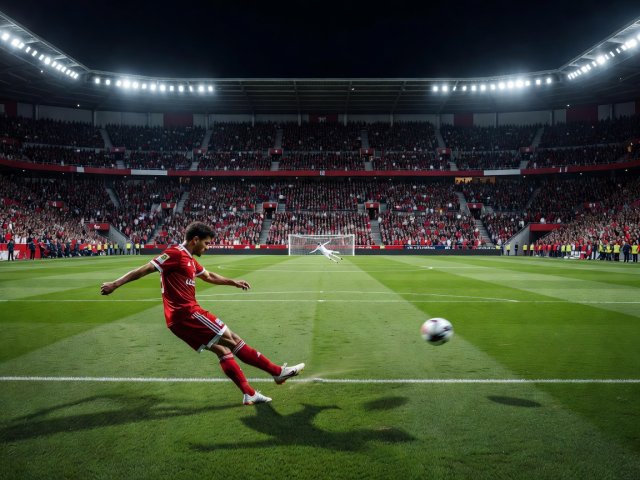
 Knuckle
Juninho Pernambucano
At Lyon in the 2000s he struck with three toes just under the centre, producing dipping, wobbling shots from distances most players would cross from.
Experiment 03 · Knuckle
The curler is predictable once you read the spin. The knuckleball is the opposite: it gives the keeper nothing to read, because even the striker does not know exactly where it will go.
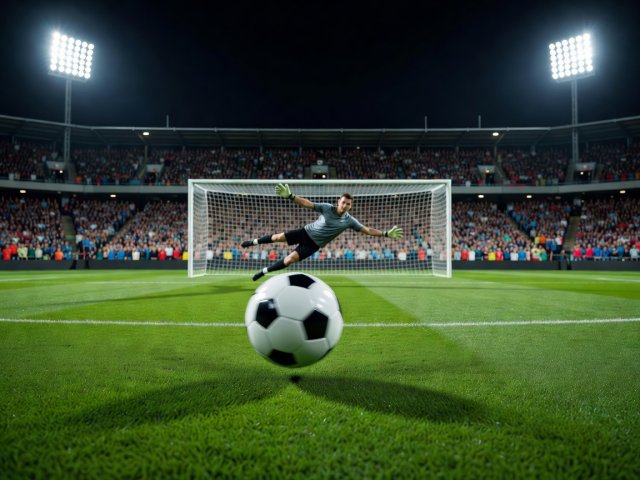
A spinning ball behaves like a gyroscope. Its rotation averages out small irregularities on its surface, so the forces on it are steady. Remove the spin and that averaging disappears.
As a non-spinning ball moves through the air, the boundary layer breaks away from its surface at points that depend on tiny details: where the seams sit, how deep the panel joins are, even scuffs on the cover. If the air separates a little earlier on the left than the right, the ball gets nudged sideways. A fraction of a second later the pattern flips. The wake behind the ball sheds vortices alternately from one side and then the other, and the ball zig-zags.
The effect is strongest at speeds near the drag crisis, where the boundary layer is on the edge between smooth and turbulent flow. Small disturbances then trigger large changes in drag and side force. That is why a knuckleball often looks stable for the first part of its flight, then darts and dips as it slows into the critical range near the goal.
Researchers Sungchan Hong and Takeshi Asai at the University of Tsukuba tested World Cup balls in wind tunnels and robot-kicking rigs. They found that the number of panels, their shape and the total length and depth of the seams all shift the speed at which the drag crisis begins.
The 2010 adidas Jabulani, with eight thermally bonded panels and a smooth surface, was criticised by goalkeepers for moving erratically at typical shooting speeds. Its successor for 2014, the Brazuca, used six panels with deeper, longer seams and a textured surface, and tested as more stable. If your training ball and match ball differ, expect your knuckle to behave differently too.
KnuckleAt Lyon in the 2000s he struck with three toes just under the centre, producing dipping, wobbling shots from distances most players would cross from.
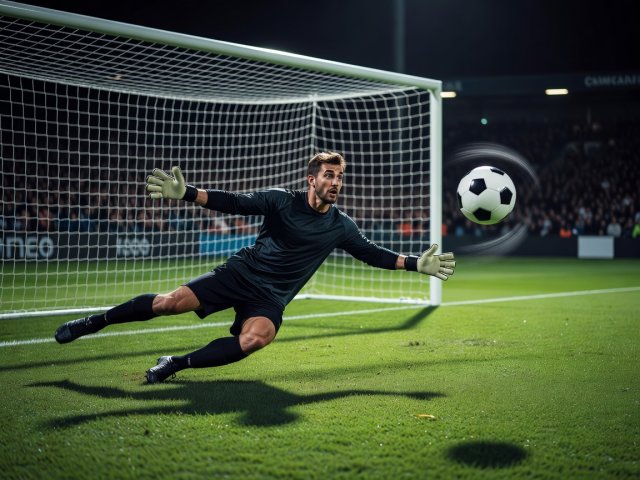 Knuckle
Old Trafford, 30 January 2008. A straight run-up, a stabbing contact and almost no spin. The ball moved after the keeper had committed.
 Power
His versions mixed knuckle with pace, keeping the ball in the unstable speed band for longer and forcing hurried saves.